
Conversion tracking
that shows what an inquiry costs
For every ad you see which inquiries and sales conversations it produced, measured with consent.
I set up the measurement myself and report every week what an inquiry and a sales conversation cost.

Clicks are cheap. Sales conversations are not. I count the conversations.
B2B conversion tracking ties every inquiry to the ad, keyword and page it came from, and follows it into sales so you see cost per conversation, not per click.
- For whom: manufacturers and industrial suppliers running Google, Microsoft, LinkedIn or Meta ads
- Online: forms, calls, calculators and downloads counted as separate goals, with consent
- Offline: qualified inquiries and won orders sent back to the ad platforms
- Report: weekly cost per inquiry and per sales conversation, by channel and campaign
What conversion tracking is, and why B2B needs more of it
Conversion tracking records what a visitor does on your website after clicking an ad: sending a form, calling, using a calculator, downloading a data sheet. A small script reports each of these events to your analytics tool and to the ad platform the visitor came from.
For a consumer shop that is often enough, because the purchase happens on the site. For a manufacturer the form is only the start. The order comes weeks or months later, after calls, drawings and a quote. Tracking that stops at the form tells you what a contact costs. It cannot tell you which campaign brings business.
Platform numbers versus sales numbers
Most companies running ads have some kind of measurement. The question is whether anyone in sales trusts it.
Platform view
- The ad platform reports conversions sales cannot find
- Phone and email inquiries show up nowhere
- Budget follows clicks and form fills
- Google and LinkedIn both claim the same inquiry
Sales view
- Every inquiry carries its ad, campaign and keyword
- Form, calculator and call count as separate goals
- Budget moves to the ads that produce sales conversations
- Qualified inquiries and orders flow back to the platforms
The one number
A campaign full of clicks and empty of sales conversations looks exactly like a good one until you track it to sales.
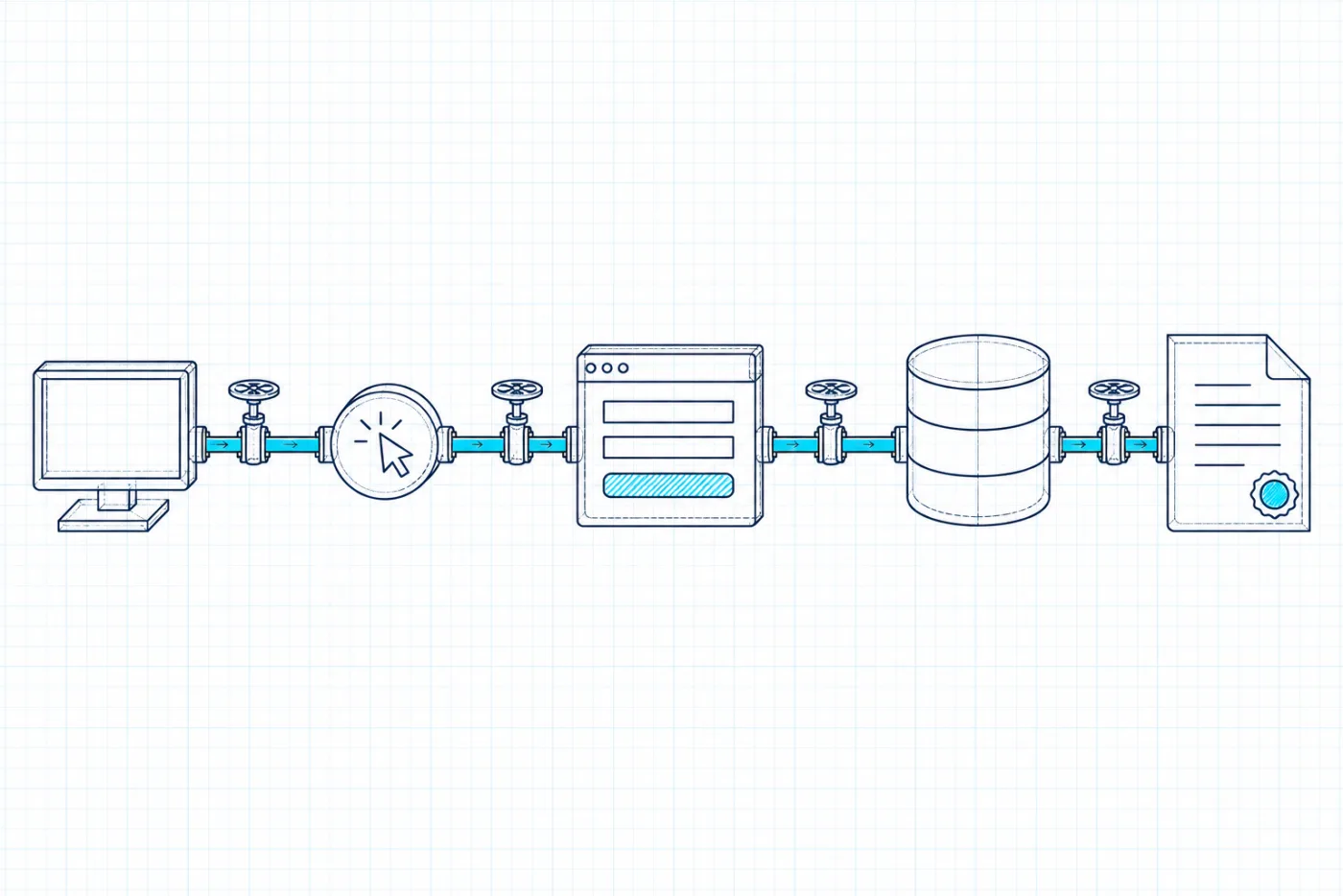
Offline conversion tracking: closing the loop to sales
Offline conversion tracking sends what happens after the form back to the ad platform: this inquiry was qualified, this one turned into a quote, this one into an order. The platform then learns which clicks lead to business, not just which ones lead to a form.
The chain has four links, and each one has to hold:
- Click ID: every ad click carries an identifier, from Google the GCLID, from Microsoft the MSCLKID, from Meta and LinkedIn their own click IDs.
- Form: the landing page passes the click ID into a hidden field of the form or calculator.
- Your records: the inquiry arrives in your system with source, campaign and click ID attached.
- Upload: when sales marks the inquiry as qualified or won, that status goes back to the platform with the click ID and a date.
Where the click ID is lost, for example because a visitor declined consent, matching by hashed email address can fill part of the gap, as far as the platform and your consent text allow it.
Offline conversions
by ad platform
Each platform takes sales outcomes back in its own way. What they have in common: the value only arrives if your own records are clean.
-
Google Ads
Imports offline conversions by click ID or through enhanced conversions for leads. Can then bid for qualified inquiries instead of form fills.
-
Microsoft Advertising
Accepts offline conversion imports by click ID as well. Smaller volumes than Google, same logic, little extra work once Google runs.
-
LinkedIn Ads
Takes offline events through its Conversions API. Useful when you target engineers or buyers by job title.
-
Meta
Receives offline events through the Conversions API. Mostly relevant for retargeting, less for reaching technical buyers cold.
From the technical ceramics campaign, July to October 2026. All attributions are lower bounds.
What a real campaign showed
When I took over the campaigns of a US manufacturer of technical ceramics in July 2026, LinkedIn reported a conversion rate of 72.6 percent. The tracking counted every product page view as a conversion. There had not been a single inquiry.
After the fix, each inquiry carried its click ID into the client's Salesforce. The first order sat there with zero campaign influence. Only when I matched company name, first contact and click data did the path appear: the ad click came in early July, the inquiry eleven days later, and the order was won at the end of August. The full story is in the technical ceramics case study.

Where offline conversion tracking reaches its limits
Sending sales outcomes back is worth it. It is not a cure-all, and four limits show up in industrial markets again and again.
- Volume: a niche product with a handful of qualified inquiries a month gives a bidding algorithm too little to learn from. The data still helps you, even if the platform cannot use it for bidding.
- Long sales cycles: each platform only accepts offline conversions within a limited window after the click. An order that closes after half a year may fall outside it, so I upload earlier stages like "qualified" as well.
- Tunnel vision: if only won orders count, the platform optimizes toward a few lucky clicks. A ladder of stages gives a steadier signal.
- Overbidding: high order values fed back as conversion values can push bids up faster than the market justifies. I set values per stage and watch them.
Tracking and privacy in Europe and the US
In the European Union most tracking needs the visitor's consent. That follows from the ePrivacy rules as soon as information is stored on or read from the visitor's device, for example through cookies, and from the GDPR for the processing of personal data. In the US the rules differ by state, and B2B sites are not automatically exempt.
In practice that means:
- Consent banner: accept and reject offered as equal choices.
- Tag management: scripts load only after consent.
- Consent mode and server-side tagging: can make the data more complete and transfer it more sparingly, but neither replaces consent.
I set up tracking so these rules are followed. It is not legal advice; your privacy policy is checked by your data protection officer or lawyer.

Who owns the setup, and how long it takes
Tracking breaks quietly. A new form, a changed thank-you page or a website update, and a goal stops firing without anyone noticing for weeks. So the most important question is not which tool, but who is responsible for keeping it right.
- Ownership: with me, one person sets up and checks the tracking, and the same person reads the weekly numbers. A drop shows up in the report, not three months later.
- Your side: someone in sales marks inquiries as qualified or won, in the system they already use. Without that step there is nothing to send back.
- Time to first data: online goals usually work within days of approval. Offline stages need a few weeks of inquiries before the first useful upload.
- Small teams: a manufacturer with one salesperson does not need an attribution platform. A spreadsheet export with click IDs, kept up to date, already closes the loop.
How your tracking comes together
Four steps, and at the end a report your sales team agrees with.
- 1
Audit and goals
What is measured today, what of it is correct, and which actions on your site count as success? Result: a list of what to keep, fix and add.
- 2
Measurement plan
I define which events are recorded, which tools receive them, how inquiries keep their source and which sales stages go back to the platforms. Result: a plan you approve before anything changes.
- 3
Setup and test
Consent, tag management, analytics, click IDs in forms and the connection to the ad platforms. Every event is tested before I trust the numbers. Result: clean data from day one.
- 4
Weekly report
You see cost per inquiry and per sales conversation by channel and campaign, and the offline stages as they come in. Result: budget decisions based on sales, not clicks.
What an audit of your current tracking usually finds
Before setting up anything new I check what the existing measurement gets right.
Double counting
Inquiries counted twice, for instance when the thank-you page is reloaded.
Missing goals
Calls, downloads and calculators are often not tracked at all.
Tags firing before consent
Legally risky in Europe and quick to spot in any review.
Numbers that do not match
Ad platform, analytics and your inbox should show roughly the same count of inquiries.
Page views as conversions
A goal that fires on a product page view produces impressive rates and no business.
The tools: use what you already own first
Specialized attribution software has its place in large marketing teams. A manufacturer with a few campaigns usually gets further with the tools that are already there.
Analytics and tag manager
Google Analytics 4 with Google Tag Manager, or Matomo if data should stay on your own servers. Enough for clean online goals.
Native platform connectors
Offline imports and conversion APIs of Google, Microsoft, LinkedIn and Meta. No extra license, more setup work.
Server-side tagging
Sends events from your own server instead of the browser. Worth it once several platforms receive the same data.
Call tracking
Separate phone numbers per source show which ad made the phone ring. Useful when buyers prefer to call.
What it costs
A fixed price for the launch phase, then cancel monthly. Your ad budget goes straight to the platform, not to me.
- Three-month launch phase: €4,990 flat
- Payment: €1,990 at the start, then two payments of €1,500
- One offer on up to two platforms
- Ad copy, images, landing page and lead magnet
- Retargeting from day one
- Prequalification of inquiries, up to 300 conversations a month
- Ongoing optimization, monthly report
- Each additional platform €290 a month
- After that €1,190 a month, cancel monthly
- Ad budget extra, from €600 a month
A case from practice
A US manufacturer of technical ceramics, a search market of 320 searches a month, July to October 2026.
What would this look like in your market? Let's find out in a short call.
Questions about conversion tracking
What is conversion tracking used for?
To see which ads, keywords and pages lead to inquiries, and with offline tracking which lead to sales conversations and orders. Without it, budget is spread by click counts.
What is a good B2B conversion rate?
There is no figure that holds across industries, and a high rate can mean a wrongly set goal. More useful is the cost per sales conversation, compared month by month.
Does tracking slow down my website?
Every extra script costs some loading time. Loading only what you actually evaluate keeps the effect small.
Do you set up a CRM?
No. I work with the system your sales team already uses and make sure each inquiry arrives with its source.
How are phone inquiries counted?
They belong in the report. How they are captured, by call tracking or by a source question in the call, we decide together with your sales team.
Tracking as the foundation
Measurement is the basis for every further improvement and for industrial marketing that is judged by sales conversations instead of clicks. What I do with the numbers is shown under conversion rate optimization for industrial websites and performance marketing with budget steered by cost per conversation. The traffic itself usually comes from Google Ads for industrial buyers. All building blocks are in the services overview.

Do you know what an inquiry costs you?
In the intro call we look at what your current tracking shows and what it misses.